WHAT ARE INVESTORS DEBATING? / AI INVESTMENTS
AWS profit rises while free cash flow shrinks. What does this prove?
A rapidly growing business and the cash left after investment can move in different directions at the same time. Using Amazon as an example, we examine what evidence is needed alongside a compelling business story. To answer, we must move from revenue to cash received over time, then to return on invested capital.
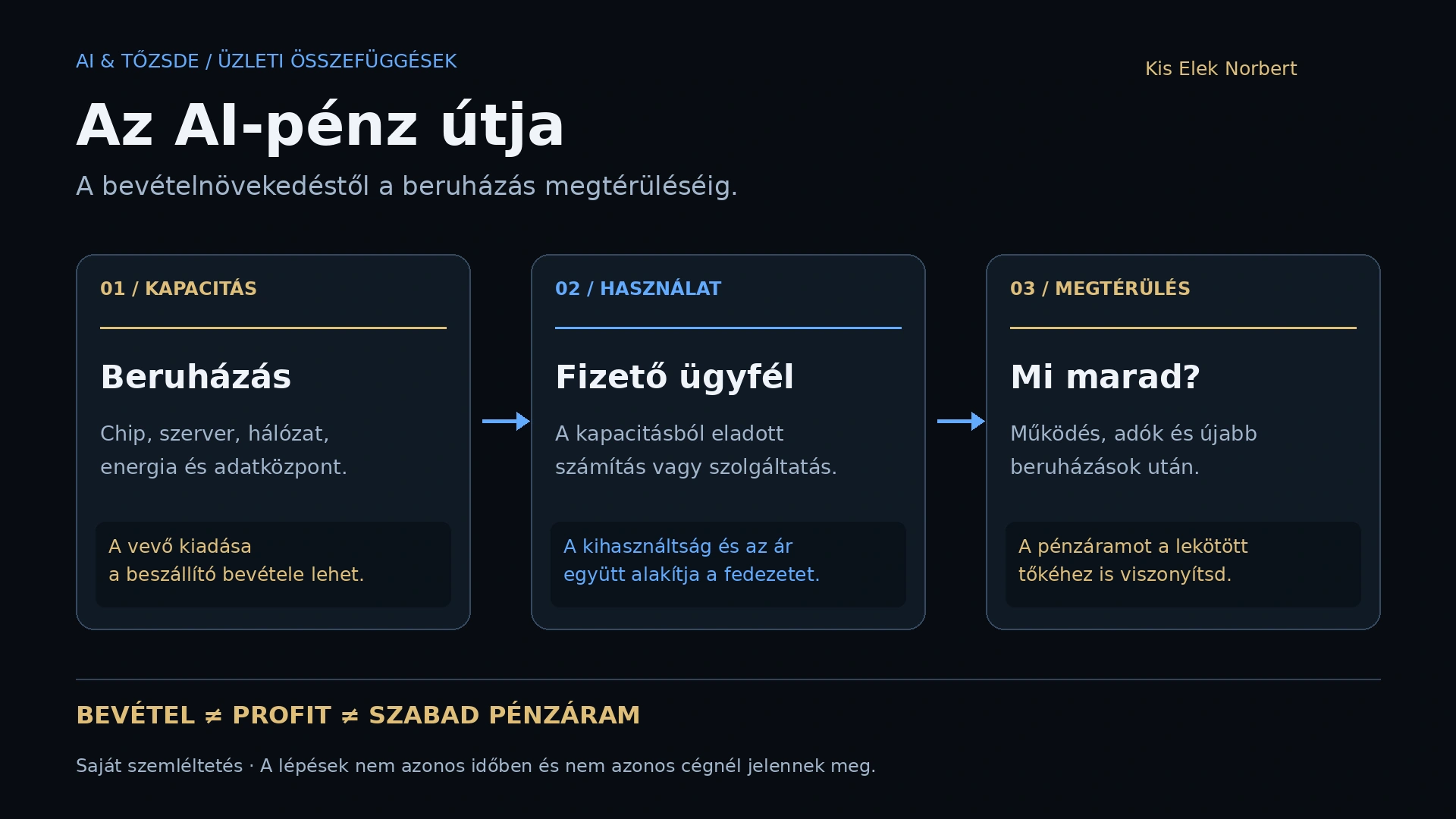
Checked: October 20, 2026. Amazon's figures relate to the second quarter ended June 30 and the 12 months then ended. Microsoft's figures relate to the fiscal quarter ended June 30. These are rechecked figures from earlier reports, not October 20 earnings releases or live prices.
Facts verified in the release
AWS figures are segment data; free cash flow relates to Amazon as a whole. The differing periods do not form a common return metric.
First, clarify the period and the metric
In Amazon's July 30 release, company-wide operating cash flow over 12 months was 161,4 billion dollars. The company attributed the decline in free cash flow primarily to increased property and equipment spending, itself mainly driven by AI investments. [1]
We interpret quarterly operating profit and 12-month free cash flow according to their different periods and content. We do not derive a separate AI project return from AWS profit; we do not calculate an AI loss from negative group-level cash flow. Revenue from the entire cloud business is broader than AI revenue.
Two interpretations with verifiable claims
The following arguments are our own editorial interpretations, not quoted community opinions.
THE OPTIMISTIC CASE
Future cash generation is being built now.
- Growing cloud revenue and operating profit show actual business performance. New capacity may lay the groundwork for later paid usage.
- The cash requirement of an investment may arise before the new capacity generates its full revenue. Today's spending may make economic sense when considered alongside later cash generation.
- The idea would be strengthened if utilization and operating cash generation improved while replacement investment and servicing costs remained manageable.
THE CAUTIOUS COUNTERARGUMENT
Revenue also needs a return on investment.
- The separate return on new AI projects cannot be isolated from the results of the cloud business as a whole alone.
- Obsolescence, price competition, financing and the cost of further investment can reduce returns even when revenue arrives later.
- A good corporate investment and a good equity investment require separate assessments. The purchase price may already reflect high expectations; we do not calculate a price target or expected return here.
Another report reveals the accounting trap
Microsoft's July 29 briefing reported operating cash flow of 55,4 billion dollars, cash expenditure on property and equipment of 35,8 billion, and free cash flow of 19,6 billion for the quarter ending in June. However, the capital expenditure measure including finance leases was 41 billion. From the next financial year, the company also revised the estimated useful lives of its data centre and office buildings; this should not be confused with the useful life of GPUs. [2]
We do not use this to rank companies by investment returns. The analytical task is to check what the metrics contain, how leases are accounted for, and changes in accounting estimates. We examine improvements in book profit separately from cash movements.
What would refute the bullish thesis?
In our interpretation, the thesis would weaken if expanding operational capacity persistently failed to bring paying usage, margins deteriorated, or comparable cash generation failed to improve even after successive investment waves. Assessment requires multiple periods and consistently defined metrics.
We monitor the timing of capacity delivery and the start of revenue together. We do not expect completed operating results from an unfinished project. One weak quarter or one strong revenue figure does not settle the debate. If detailed data are not public, uncertainty remains.
What we will check in the next reports
- Paying usage
- After capacity comes online, do contracts turn into actual revenue? Are utilization or customer retention disclosed?
- Cash generation
- Using the same period and definitions, how do operating cash flow, capital expenditure and free cash flow change?
- Economic useful life
- How much replacement investment is needed? What do leases, depreciation or changing depreciation estimates cover?
- Value per share
- Alongside financing, dilution and the purchase price, under what conditions would the improvement reach shareholders?
This is a forward-looking checklist. The article does not claim that subsequent data have already confirmed the return on investment.
Rising operating profit and negative free cash flow can coexist during an investment phase. Evidence of AI returns can come from the investments' entire life cycle and subsequent cash generation relative to the cost of capital.
Sources and origin of the question
The section was inspired by r/stocks discussions about companies and AI investment. The title and question are our own editorial wording, not a translation of comments or a popularity ranking. Financial facts are sourced from the two companies' official releases. Checked: October 20, 2026.
- Amazon – 2026 second-quarter earnings release ↗Primary source · Release: 30 July 2026
- Microsoft – FY2026 Q4 management briefing ↗Primary source · Released: 29 July 2026.
- r/stocks – community discussions about companies ↗The section's inspiration; not financial evidence.